
Tuesday, January 27, 2015
Charlie Hebdo and Europe’s Inability to Get Angry - Part Two
by Tom Kando
In my previous post, I asked whether the European opinion leaders had lost the capacity for anger when Europeans are under attack.
Obviously, there are still plenty of people in Europe who are capable of anger. These are the politically incorrect. They are the rednecks. They are the equivalent of what Jerry Falwell used to call the “silent majority.” They represent the political RIGHT. Many of them support very unsympathetic characters, some of them with fascistoid tendencies. They are “populists,” often nativists, and racists. They follow demagogues such as Geert Wilders in Holland and his equivalents elsewhere. France has Marine Le Pen, fretting about the Arabization of her country. Hungary has its Jobbik movement, a sinister fascist group that has lynched gypsies. There are the people who recently attacked, damaged and burned mosques in Sweden. There are the people who have been marching to kick immigrants out of Germany. It is noteworthy that xenophobia is strongest in the EASTERN part of Germany, precisely where there are the fewest immigrants. These groups are the equivalent of America’s Tea Party and its Republican Party.
Read more...

Charlie Hebdo and Europe’s Inability to Get Angry - Part One
 by Tom Kando
I just spent nearly three weeks in Europe. I was there for elder care. My mother is nearly 102. She recently fell, so my sisters and I had to go help out. Going back and forth across half the world is becoming increasingly tedious for me. I do this a lot, and I am exhausted, sometimes becoming sick myself from the stress and the hassles. But this isn’t what I want to write about. I am going to write about world events and my trans-Atlantic perspective on them.
I also just saw “American Sniper,” and I am struck by the contrast between the European and the American responses to (Muslim) violence. The Clint Eastwood/ Bradley Cooper film is reasonably entertaining, but its extreme popularity disturbs me. It has broken all box office records.
American patriotism and flag waving have been at an all-time high since 9-11. But it is faux patriotism: We paste ribbons on our cars and we send the professionals to fight and die. Fewer than half of one percent of us “defend freedom.” Things were different when there was a draft, as during the Vietnam war. I am not condoning the terrible way veterans were treated then. I’m just saying that back then, most Americans were not as gung-ho for war, because their own hide was at stake. Applauding at the end of “American Sniper” is easy. Read more...
Saturday, January 17, 2015
'Muslims Urged to Condemn Terrorists: What Madness!'
 by Madeleine Kando

A few days after the terrorist attack on the Charlie Hebdo magazine in Paris, an article appeared on the French News website Rue89 entitled: 'Muslims urged to condemn terrorists: What Madness!'
Here is a brief translation: 'It is absurd that we ask Muslims to dissociate themselves from Islamic barbarism! It is like asking women to dissociate themselves from Nabilla (a curvaceous French reality show star). Why do Muslims feel they need to condemn this heinous act more strongly than others? Why have the British Muslims launched an anti-terrorism campaign under the slogan "Not in My Name"? It presupposes that every Muslim is connected to Islamist terrorism and that it must publicly cut this link. This logic falls under what is called "Islamophobia". It's a crazy logic. So insanity against insanity, here is a list of 'désolidarisations' that should have been required. who knows why it didn't.'
The article then has a long list of absurd examples, to prove their point, such as 'We don't ask divers to dissociate themselves from those who sank the Rainbow Warrior, etc.'. The list casually also includes statements such as: 'We did not ask Christians to distance themselves from the Ku Klux Klan' and 'We did not ask the Basques to dissociate from the terrorist actions of ETA'. Read more...
Friday, January 9, 2015
Do Generations Repeat Themselves?
 by Madeleine Kando
We don't need experts to tell us which generation we belong
to in the familial sense. We know it when we look in the mirror. We all go through
the same stages of life: childhood, young adulthood, midlife, old age and for
the lucky few, late old age.
Before the 19th century, when people looked at the world as
a fairly static place, even the social meaning of a generations simply meant 'all men (and women) living more or
less at the same time' (Emile Litré). One batch of living beings was replaced by
another when they died, like water flowing through a river. In that sense,
my 101 year old mother, my daughter, my 3 year old grandson and I are considered
one generation.
But when society began to be viewed as progressing, not
just in time but also qualitatively, experts began to look at generations as
groups of individuals born during a certain period, whose character was
influenced by the historical events of their time. It became a tool to form a
collective identity. Now we are not only subdivided by age, but by our
experiences and we are assigned certain characteristics. If you are part of the
'Greatest Generation', you are 'a conservative saver, hard-working, with a high
sense of moral obligation, patriotism and respect for authority'. If you
are a baby boomer, you are 'experimental, individualistic, free spirited and social cause oriented'. Even the newest cohort, still in their
diapers, has already been labeled. The Homeland or Alpha generation will be 'the most formally educated, most materialistic and technology-focused.'
Read more...
Saturday, January 3, 2015
Our Best Wishes for the Winter Solstice
 Dear readers
We were going to wish you a Happy New Year, as we have done these past years, but after legal counsel, we were advised to rethink our actions, since wishing you a good year, good health and prosperity would submit us to a liability risk. Therefore, we are posting a corrected version of our wishes, which is in compliance with the precautionary principles brought to our attention.
New formulation: We ask you to accept, without any obligation implicit or explicit on your part, our best wishes on the occasion of the winter solstice and the first of the year, in line with the tradition, the religion or the existentialist values of your choice, including your right to demonstrate your indifference to popular festivities as scheduled.
These wishes are more particularly:
1) health: this does not mean that we are assuming any particular knowledge of your medical record, or of any desire to interfere with the confidential dialog established with your physician or your insurer. Read more...
Monday, December 29, 2014
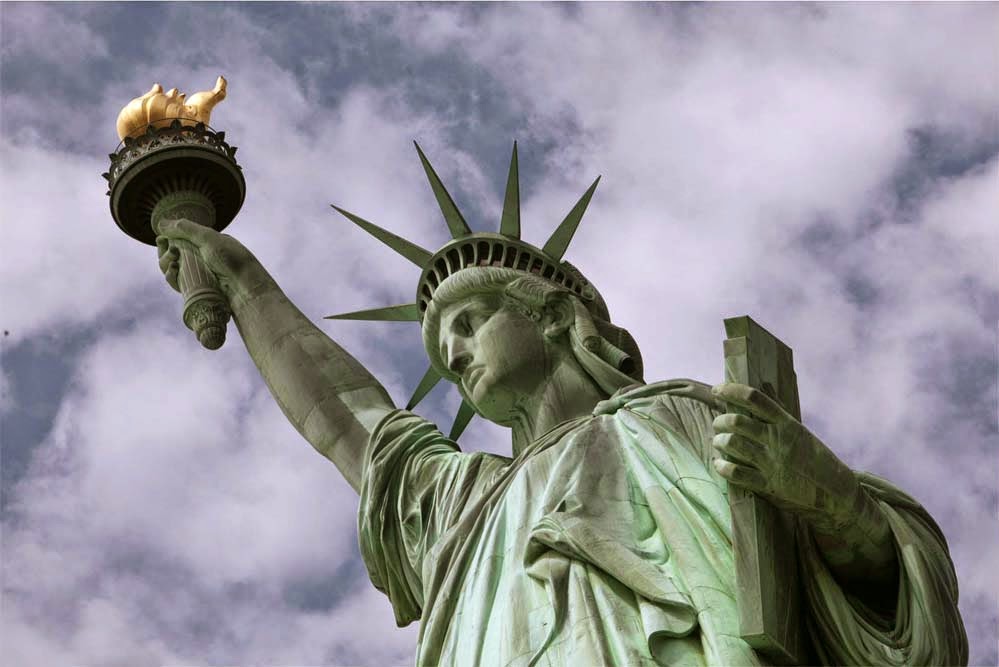
In Praise of Immigrants
 by Madeleine Kando
I am an immigrant. A documented one, from a Northern European country. I am an immigrant through and through and proud of what I have become because of it. I began my immigrant career at the age of four, when my family moved to France from Hungary, right before the Iron Curtain closed off many of the countries of Eastern Europe and made them satellite states of the Soviet Union.
A child of a mixed marriage between a Jew and a Gentile, born amongst the rubble of World War II, I became a political refugee and grew up in Paris and Amsterdam. You couldn't ask for a better apprenticeship if you are an aspiring immigrant.
I consider myself lucky to have had the privilege of living my life where several cultures meet. Maybe because of my gypsy roots, I have always felt a sense of adventure by moving about and living in new places. There was a childish excitement brewing in me, especially when I came to America. It was huge, wild and seemed to fit my disorderly and chaotic nature. Read more...
Saturday, December 27, 2014
The Interview: Funny and Audacious, or in Bad Taste?
 by Tom Kando
We saw “The Interview” the first night it was out. It was a full house. We had to use Fandango, which until then I thought was the most useless company in the world...
My purpose today is not to summarize the movie for you, but to discuss the REACTION to it.
I liked the film a lot. I found it extremely funny and politically relevant. So sue me for bad taste.
By now most people know what it’s about: two American tabloid-TV show hosts are hired by the CIA to assassinate North Korea’s baby-faced supreme leader Kim Jong-un. The two men - played by James Franco and Seth Rogen - are bumbling buffoons. I already knew that Rogen is funny, but I was surprised by how funny James Franco can be. Read more...
Tuesday, December 16, 2014
The Dutch Obsession with Diminutives
 by Madeleine Kando
The Dutch are statistically the tallest people on earth. Not only are they tall, but every time I travel to Holland, they seem to have grown taller. Whatever feeling of confidence and superiority my above-average height might give me in the US, it evaporates the moment I arrive at Schiphol airport, and start to navigate my way through a sea of giants. It's hard to get used to feeling 'short', even if it's just for a week or so.
You would expect this propensity for height to spill over in the way the Dutch speak, with bombastic, aggrandizing words and phrases. But it's just the opposite. The Dutch are extremely fond of diminutives. They add the suffix '-je' or '-tje' to practically any part of speech. When I visit my friend Edith in Baarn, we often go for a 'fiets tochtje', a little bike ride (even though they might take up to three hours). We'll stop on the way for a 'kopje coffee met een gebakje', a little cup of coffee with a little desert. On our way back, we'll go into town and buy a 'jurkje', a little dress or hunt for a 'koopje', a little bargain. It's all little this and little that in Holland. Read more...
Saturday, December 6, 2014
Hand to Mouth: Poverty in America
 by Madeleine Kando
In her recent book 'Hand to Mouth: Living in Bootstrap America', author Linda Tirado discusses what it's like to work 3 low wage jobs and still not be able to make ends meet. She openly and unabashedly shares the daily realities of her life as a low-wage worker and demonstrates "that poverty is not a ‘culture’ or a character defect; it is a shortage of money.”
Tirado's book tries to destroy one of the most tenacious myths about poverty - that poor people are where they are because they are 'different'. Contrary to the European view, that being poor has more to do with an accident of birth or just bad luck, Americans tend to blame poverty on a lack of work ethic or laziness.
But, as Tirado explains: 'working hard does not mean that you will get ahead. Wages are often too low to live on, and employers steal income from employees. This is why so many people can work, even at multiple jobs, and still be poor. Journalist Barbara Ehrenreich, author of 'Nickel and Dimed: On (Not) Getting by in America', went 'undercover' as a low wage worker and found that 'the work required incredible feats of stamina, focus, memory, quick thinking, and fast learning.'
This book should be required reading for politicians like Paul Ryan who are trying to gut our safety net and who insist, against all evidence, that if you are poor in America 'it is because of your own failure to be sufficiently diligent, chaste, sober, or thrifty.'(See: 'Just How Much Does Paul Ryan Want The Government To Plan Poor People's Lives?')
Although the poverty rate started to go down throughout the 1960s (thanks to Johnson's War on Poverty when he signed the Economic Opportunity Act in 1964), it began to rise again in 1980. Now, about 50 million Americans live below the poverty line, which the federal government defines as an annual income of $23,550 for a family of four.
Read more...
Wednesday, December 3, 2014
Do we need more “Freedom,” Like the People in 'Mockingjay"?
 by Tom Kando
The prevailing trend today is to favor “freedom,” and to hate the government, particularly the big, distant, central government. “Local” and “grassroots” are seen as good things, going hand in hand with “freedom.”
Popular culture is also on that side, of course, as I was recently reminded by the wildly popular Mockingjay, the third Hunger Games movie. It’s not my intent to dignify this mediocre picture with a review or a serious political analysis, as it is essentially a money-making piece of entertainment, which is fine. But it shows precisely the ideological confusion which I want to talk about:
The main theme of the entire Hunger Games series is that of an evil central government (Capitol) that oppresses the local districts, which then start a revolution. It is a story about the quest for freedom at the grassroots level vs. the tyranny of the central government. As banal as could be. The story of every revolution in history - the American, the French, the Russian, you name it. Read more...
Subscribe to:
Posts (Atom)





